
Blog
A 62% report card can’t tell you what to fix
You open the report card. Mathematics: 62%.
Is that “okay”? Is it a crisis? Should you hire a tutor tonight — or wait for the next unit test?
The honest answer is: the percentage cannot tell you. A report card average compresses dozens of skills into one number. Fractions, place value, word problems, and order of operations can all hide behind the same 62%. Until you know which idea is broken, you are guessing what to practise.
This guide is for parents who want to spot learning gaps early — at the homework table, not only after the next exam — and turn a vague “weak in Maths” into a named problem you can actually work on.
What a learning gap actually is
A learning gap is not “your child is bad at Maths.” It is a specific idea that did not stick, while later chapters keep building on it.
Classic pattern: the child “understood it in class,” then goes blank at home. Or they skip a chapter because it feels hard, then the next chapter feels harder for no clear reason. Or they keep making the same type of mistake — not random careless errors, but the same wrong rule applied again and again.
Gaps love averages. Averages look tidy. Gaps are messy and specific.
Signs parents can spot before the next exam
You do not need a diagnostic lab. You need attention to patterns that percentages erase.
1. Homework tears (or sudden shutdown)
Tears, anger, or “I can’t” that appears on one topic but not others is useful data. Emotional load often shows up where understanding is thin — especially when the child cannot say what they do not understand.
Ask gently: “Which step stopped making sense?” If they can only say “all of it,” the gap may be earlier than the worksheet title suggests.
2. Chapter-skipping and “we’ll catch up later”
Skipping is sometimes strategy. More often it is avoidance of a foundation that already feels shaky. Later chapters do not forgive missing place value, fraction sense, or how operations should be ordered.
If a chapter is being postponed week after week, treat that as a gap signal — not as a time-management issue alone.
3. “Understood in class, blank at home”
Class can feel clear when the teacher scaffolds every step. Home removes the scaffold. If the child can restate the method only while looking at the board notes, they may have memorised a procedure without owning the idea.
A useful check: ask them to teach you one example with the book closed. Teaching exposes the gap faster than nodding along.
4. The same mistake type, repeating
This is the highest-signal sign. Random slips happen. A named misconception repeats.
Example parents recognise in CBSE-style Maths: the child reads every expression left to right, so 2 + 2 ÷ 2 becomes 4 instead of 3. The child is not “careless.” They are applying a wrong but consistent rule. Until that rule is named and replaced, more worksheets mostly rehearse the error.
Another frequent pattern with fractions: adding tops and bottoms straight across (1/2 + 1/3 = 2/5) because “add everything you see.” Again — consistent, nameable, fixable.
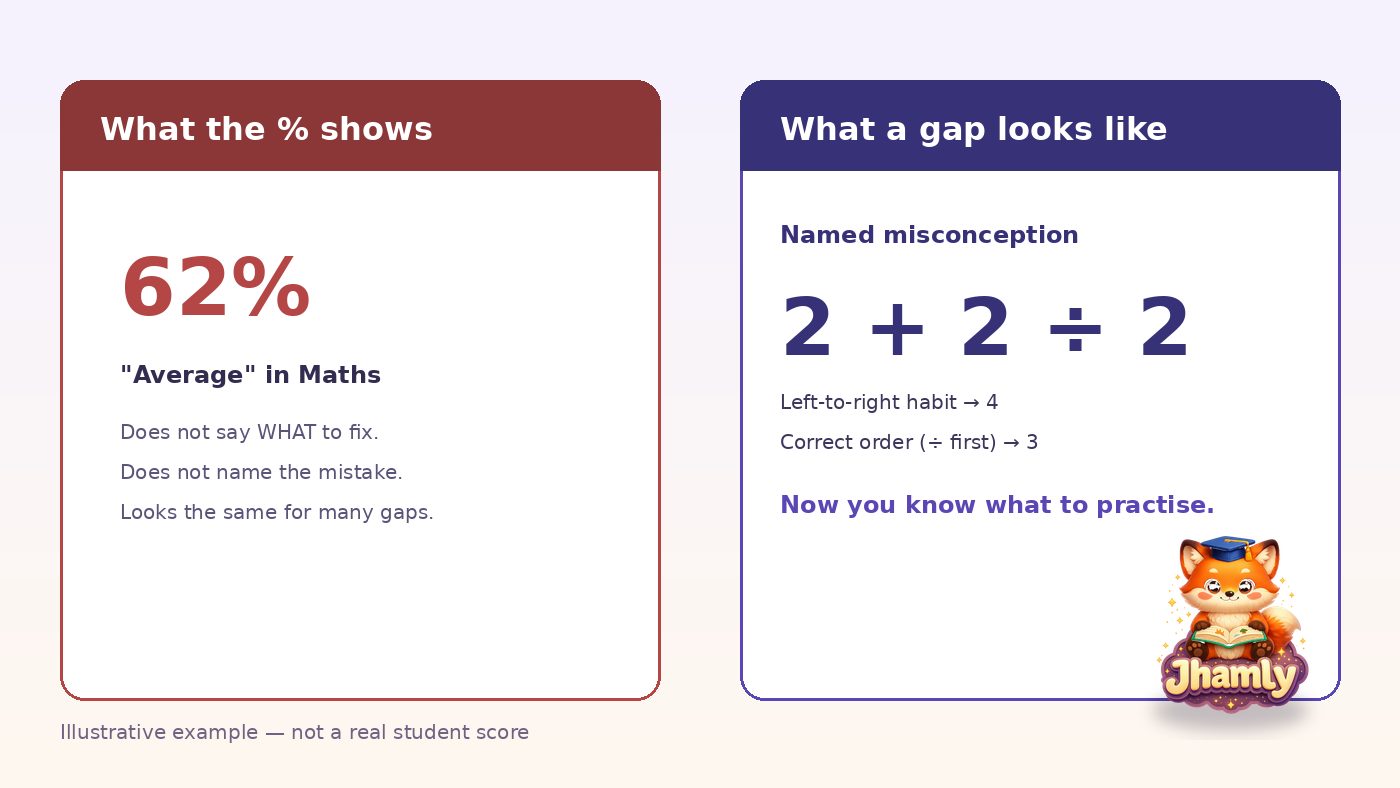
Percentage vs named misconception
| What you see | What it usually means | What to do next |
|---|---|---|
| 62% in Maths | An average across many skills | Do not only “do more Maths” |
| Tears on one worksheet type | A local gap or overload | Isolate the stuck step |
| Same wrong answer pattern | A named misconception | Practise that rule with feedback |
| Fine in class, blank at home | Scaffold dependence | Ask them to teach one example unaided |
The goal is not a harsher report card. The goal is a sentence you can act on: “Order of operations — division before addition,” not “needs to improve.”
A worked CBSE-style example (illustrative)
Suppose the child writes:
2 + 2 ÷ 2 = 4
If you only see “wrong,” you might drill mixed operations until everyone is tired. If you name the gap — left-to-right reading instead of operation order — practice becomes short and targeted:
- Sort symbols: which operation comes first?
- Compute that step alone.
- Then finish.
One clear misconception beats twenty unmarked sums. (This example is illustrative. It is not a claim about any real student’s score.)
What “proof” looks like for a parent
Spotting a gap is step one. Confirming that practice moved the needle is step two.
On how a parent reads the proof, we talk about receipts you can actually check — not vibes. In Jhamly’s design:
- Wrong answers can map to named misconceptions (for example, that left-to-right habit above).
- Practice questions are verified before the child sees them; when the tutor is unsure, it says so.
- Quizzes can stay silent so scores reflect the child; home practice is labelled home-verified.
- Parents can see full transcripts. Tutoring data is not shown to schools — aligned with a DPDP-minded split between home learning and school systems.
You can also see how the teaching loop works on How it works and what parents get on For parents.
Coverage honesty (so you do not over-claim at home either)
Jhamly is deepest on Maths Grades 3–8 as the fully tutored set today. Board maps include CBSE Grades 3–12 and ICSE & KSEAB Grades 3–10, with honest gaps called out on the syllabus page. For a CBSE-focused walkthrough, see AI tutor for CBSE. If you are comparing a generic chatbot to a tutor built for school children, read AI tutor vs ChatGPT.
We will not invent score lifts, ranks, or school counts. Beta access is free.
A simple weekly habit (15 minutes)
- Pick one subject where the report card felt opaque.
- Collect two recent mistakes of the same type (homework or test).
- Write one sentence naming the rule that failed.
- Practise only that rule for a short block — then stop.
- Ask the child to teach the corrected rule back to you once.
If you cannot name the rule after two mistakes, that is still useful: you have found where a human teacher — or a tutor that remembers the struggle across sessions — needs to look next.
Safety questions (who sees what, what the AI is allowed to do) belong on Safety.
See how AI can help identify learning gaps
Jhamly’s philosophy is simple: AI should make education more personalised, measurable, and human — not replace teachers. Memory across sessions, named misconceptions, verified practice, and parent-visible transcripts exist so a 62% becomes a plan, not a shrug.
Join the beta — it is free while we learn with families.